
The US Department of Housing and Urban Development (HUD) recently released data from the 2025 Point-in-Time (PIT) count, an annual estimate of homelessness across the country.[i] Conducted each January, the PIT count provides an estimate[ii] of the number of people experiencing homelessness on one night during the year and is one of the country’s most important measures of housing instability. Because the PIT count occurs on a single night, it does not capture everyone who experiences homelessness over the course of a year. Nevertheless, it provides a valuable benchmark for understanding trends and identifying emerging challenges.
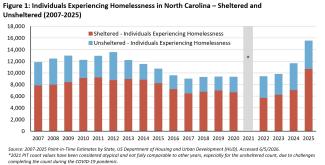
While homelessness declined modestly nationwide from January 2024 to January 2025 (-3.3% or -25,828 people), North Carolina experienced one of the largest increases in the country. According to the 2025 data, homelessness in North Carolina increased by approximately 33.4% (+3,886 people) between 2024 and 2025, making it the largest percentage increase among all states and the second largest numerical increase, following only Oregon.[iii]
Of the 15,512 individuals experiencing homelessness in North Carolina in January 2025, 10,712 were sheltered[iv] (i.e., staying in an indoor, supervised temporary living arrangement like an emergency shelter) and 4,800 were unsheltered, meaning they lived in places not meant for human habitation (e.g., cars, parks, tents, abandoned buildings, etc.).[v] That’s an increase from the previous year, when the state saw 11,626 individuals experiencing homelessness (7,103 sheltered and 4,523 unsheltered).
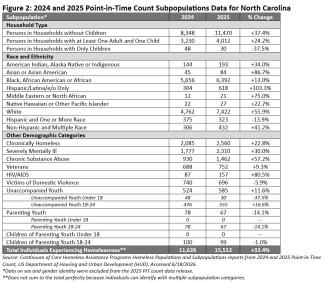
North Carolina also saw increases in many subpopulation categories tracked by the PIT count between the 2024 and 2025 counts, from people in families to every race and ethnic group to veterans (see Figure 2 below). One of the categories with the largest increase relative to other states was people in families with children (households with at least one adult and one child): North Carolina saw an additional 782 people in families with children experiencing homelessness from 2024 to 2025 (+24.2%). Overall, 19 states and territories reported increases in the number of people in families experiencing homelessness with Delaware (+21.4%), Iowa (+21.0%), Louisiana (+21.7%), Maryland (+35.8%), Montana (+24.9%), North Carolina (+24.2%), South Dakota (+40.1%) and West Virginia (+26.7%) all reporting increases of more than 20%.
Even with increases estimated across most subpopulations, there were several subpopulations that saw decreases. For example, the number of people in households with only children (i.e., unaccompanied youth under 18) fell from 48 to 30 statewide (dropping from 0.41% to 0.19% of the total number of individuals experiencing homelessness), with decreases also among victims of domestic violence and people under age 25 who are parents (parenting youth).
North Carolina’s increase in the number of individuals experiencing homelessness likely reflects a combination of long-term housing affordability challenges and the impacts of Tropical Storm Helene, which displaced thousands of North Carolinians in the second half of 2024. The geographic distribution of the increase reinforces this finding (see Figure 3 below). In the Asheville-Buncombe County area, the number of individuals experiencing homelessness more than tripled between 2024 and 2025—from 739 to 2,303 individuals—which accounted for more than a third of the statewide increase. The NC Balance of State Continuum of Care (BoS CoC), which is responsible for conducting the PIT count in 79 of the state’s 100 counties (26 of which were Helene-impacted counties[vi]), saw an increase of 2,566 (or +61.4%), accounting for more than half of the statewide increase.
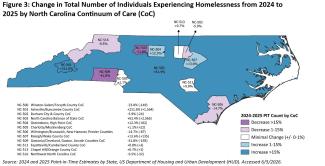
Many of the western NC residents displaced by Helene were still living in temporary accommodations when the PIT count was conducted in January 2025, including hotels supported through federal disaster assistance programs. For the 2025 PIT count, the Asheville-Buncombe County CoC reported that unsheltered homelessness increased 50% (from 219 to 328 people) and that among those unsheltered, 35% reported becoming homeless because of Tropical Storm Helene. This increase is due, at least in part, to damage to the region’s shelter and transitional housing stock, including ABCCM’s 250-bed Veteran Restoration Quarters. In addition, the 2025 PIT count includes at least 1,500 people residing in hotels/motels provided through FEMA’s Transitional Sheltering Assistance Program.[vii] The FEMA hotel/motel population alone is roughly twice the size of the 2024 count in Asheville-Buncombe County, reinforcing that disaster-related displacement likely contributed to the statewide increase in homelessness.
The 2025 PIT count also highlights broader housing affordability challenges that predate Helene: North Carolina continues to experience strong population growth, rising housing costs and a shortage of affordable rental homes in many communities.[viii] For households already living with tight budgets, unexpected emergencies like job loss, medical crises or natural disasters can quickly lead to housing instability. For the NC Housing Finance Agency, these findings reinforce the importance of expanding affordable housing opportunities and supporting efforts that help North Carolinians remain safely housed in their communities.
To learn more about the Agency’s sustained investments in affordable rental housing, supportive housing, homelessness prevention and disaster recovery, visit https://www.nchfa.com.
For more information specifically on the Agency’s programs to build and rehabilitate emergency, transitional and permanent housing for people who are experiencing homelessness or at imminent risk of homelessness, have disabilities or other special needs, visit https://www.nchfa.com/rental-housing-partners/supportive-housing-developers. While the 2026 funding rounds are currently underway, more information on 2027 opportunities will be released in the early fall.
-------------------
[i] The Point-in-Time count is conducted annually by local Continuums of Care and community partners across the country. Volunteers and service providers identify individuals and families experiencing homelessness in shelters, transitional housing programs and places not intended for human habitation. The resulting data are used by HUD, states and local communities to inform policy decisions and allocate resources.
[ii] While the PIT count is the primary tool for estimating the number of individuals experiencing homelessness across the United State, it is widely considered to be an undercount. Because the count only captures homelessness on a single night during the year, it can exclude those who are temporarily staying with others or residing in locations that are difficult for outreach teams to identify or reach. It also varies in methodology and thoroughness across communities and can fail to fully capture families, youth and others not connected to social service or shelter systems.
[iii] 2007-2025 Point-in-Time Estimates by State, US Department of Housing and Urban Development (HUD). Accessed 6/5/2026. Available here.
[iv] Per HUD’s PIT count guidance, “sheltered” homelessness refers to people who meet HUD’s homeless definition and who are staying, on the PIT count night, in a supervised temporary living arrangement—specifically Emergency Shelter (including hotel/motel stays paid for by charitable or government programs), Transitional Housing or Safe Havens. For more information, see PIT Count Standards and Methodologies.
[v] Per HUD’s PIT count guidance, “unsheltered” homelessness refers to people who meet HUD’s homeless definition and whose primary nighttime resident, on the PIT count night, is a place not designed for human habitation, including a car, park, abandoned building, bus or train station, airport or camping ground. For more information, see PIT Count Standards and Methodologies.
[vi] 26 of the 39 North Carolina federal disaster declared counties for Tropical Storm Helene fall within the NC Balance of State (BoS) CoC. The remaining 13 are covered by other CoCs (e.g., Asheville/Buncombe, Winston Salem/Forsyth, Charlotte/Mecklenburg, Gastonia/Cleveland/Gaston/Lincoln and Northwest NC). BoS counties among the 39 include Alexander, Burke, Cabarrus, Caldwell, Catawba, Cherokee, Clay, Graham, Haywood, Henderson, Iredell, Jackson, Lee, Macon, Madison, McDowell, Nash, Polk, Rowan, Rutherford, Stanly, Surry, Swain, Transylvania, Union and Yadkin.
[vii] The City of Asheville, March 28, 2025. “Continuum of Care (COC) releases 2025 Point-in-Time Count numbers,” available here.
[viii] See, for example, the suite of NC Housing Finance Agency Policy Matters Blogs, including the June 2026 blog entitled “North Carolina’s Population: Growth and Demographic Shifts,” available here.