
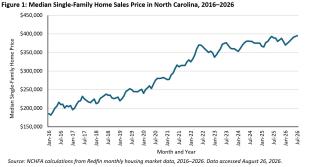
Home ownership has become increasingly out of reach for many households in North Carolina and across the country. In the last five years alone, the median single-family home price in the state has grown from $311,500 (July 2021) to $395,500 (July 2026), a 26.9% increase[i] (see Figure 1 below). At the same time, the number of households facing cost burden (spending 30% or more of income on housing costs) has also been on the rise: 51.5% of renters experienced cost burden in 2024, up from 46.4% in 2019[ii]. This is making it harder for renters hoping to enter home ownership. Unaffordable rents—along with high interest rates and home prices—can make it difficult to save for a down payment and future monthly mortgage costs.
Despite these challenges, many families still dream of owning a home, pursuing the stability and community ties that come with it. While today’s market can feel discouraging, different programs and approaches throughout the state have been making home ownership a reality for many families. From financial assistance and affordable mortgages to long-term, community-based affordability and non-traditional development models, organizations around the state have been working for years to make home ownership more affordable.
No single strategy fits every household or community, but together, these approaches create a more accessible path to affordable home ownership in North Carolina.
Lowering Upfront Barriers to Home Ownership
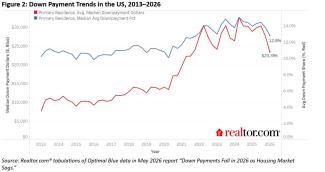
For many home buyers, the most immediate obstacle for home ownership is the down payment needed at closing. The median conventional down payment in the United States was $23,396 in the first quarter of 2026 (see Figure 2 below). Only 10% to 20% of renters in the US have enough to cover such a down payment, creating a significant barrier to first-time or low-income home buyers[iii].
Down payment assistance in North Carolina is available from state, local and nonprofit organizations to help reduce the upfront cash needed to purchase a home. The NC Housing Finance Agency’s down payment assistance programs—including the NC 1st Home Advantage Down Payment and the Community Partners Loan Pool (CPLP)—provide $15,000 and up to $50,000, respectively, as a zero-interest, subordinate loan. This support can be combined with funding from local governments and nonprofits to increase total assistance, allowing buyers to overcome those initial cost hurdles and build equity faster.
Providing More Affordable Mortgage Solutions
Lowering a buyer’s monthly mortgage payment can play an equally important role in making home ownership affordable. One approach to accomplishing this aim is to reduce interest rates, permanently or temporarily, to help buyers manage costs and make it easier to enter the market, especially in the current higher-rate environment. Fixed-rate loans guaranteed by federal agencies like the United States Department of Agriculture (USDA) or Veterans Affairs (VA), as well as other products offered by the NC Housing Finance Agency, often provide lower or more competitive interest rates. This can lead to more predictable, affordable payments that can be combined with down payment assistance to enhance overall affordability.
Beyond government-backed mortgages, some large homebuilders and even individual sellers offer temporary mortgage rate buydowns to reduce monthly payments for the first few years of a loan. A mortgage rate buydown is when a developer or seller pays a lump sum to the lender to temporarily reduce the buyer’s interest rate. This lower rate could apply for any number of years during the life of the loan, depending on how much the builder is offering and how the money is applied. This can help buyers who need more time to adjust to full mortgage payments or those who expect income growth.
There are several additional ways to achieve more affordable mortgages including sweat‑equity programs (like the Agency’s Self-Help Loan Pool in partnership with Habitat for Humanity affiliates) that allow buyers to trade labor for a lower home price or reduced closing costs.
Community-Focused Long-Term Affordability Models
Some home ownership models focus not only on helping a household buy a home, but on preserving affordability for future buyers as well. These community-focused affordability models employ a range of methods, including separating the cost of land the home’s price, setting resale price restrictions or using collective ownership to stabilize costs.
One of the most widely used approaches in this space is the community land trust (CLT) model. In a community land trust, an organization (typically a nonprofit) acquires land to create permanent affordability. Home buyers purchase a home, but lease the land through a long-term, renewable lease. Resale-price formulas are also often used to limit how much the home price can increase, making sure that the home is affordable to the next buyers. By removing the cost of land from the home price and managing resale prices, CLTs are able to create opportunities for long-term affordability.
Housing cooperatives pursue similar goals through a different structure. Instead of purchasing a single home, households purchase a share in a resident‑governed cooperative that owns all homes in the building or neighborhood. Members collectively manage the property and agree to resale restrictions that keep costs stable and entry prices attainable. Some cooperatives allow shares to be sold at market rate, while others have price caps in place to maintain affordability.
Expanding the Range of Housing Types
In addition to financial tools and mortgage products, some communities across North Carolina are changing zoning and land use regulations to make home ownership more affordable. Traditional single-family zoning can limit neighborhoods to detached homes on larger individual lots, which restricts the number of homes that can be built.
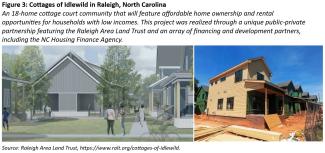
To expand options and lower costs, many communities in the state now allow a broader mix of housing types or streamline certain zoning requirements. Smaller lots, modest square footage and neighborhoods that include single-family homes alongside more dense housing (e.g., townhomes, duplexes, triplexes, accessory dwelling units (ADUs) and cottage court developments (a community of small, detached single-family homes often oriented around a shared green space)) are becoming more common. Sharing land and infrastructure costs across multiple homes can support an increase in the supply of affordable homes, help reduce per-home costs, be responsive to neighborhood needs and expand choices for buyers[iv].
In a similar vein, prefabricated homes—including manufactured homes and modular homes—are factory‑built to federal standards and can offer a faster, lower‑cost path to home ownership. Off-site development can streamline labor, simplify the design process, reduce material costs and waste and avoid weather delays. This can result in a reduction of overall development costs and, by extension, monthly housing costs can be lower.
Conclusion
No single strategy can solve every price challenge that home buyers face in the market, but together, these approaches and programs offer a broader and more flexible path to home ownership in North Carolina. Lowering upfront costs, improving mortgage affordability, preserving long-term community stability and expanding the range of housing types all play important roles in supporting households with different needs and financial situations. To learn more about the Agency’s home buyer programs, visit https://www.nchfa.com/home-buyers.
Each community and buyer will require a different mix of tools to help them become a homeowner. Not all strategies described here are available through the Agency’s home buyer programs; they illustrate the wider set of affordable options offered by partners and local initiatives. As households navigate their options, it can be helpful to speak with housing counselors, lenders or real estate agents who can explain available programs and guide buyers toward approaches that fit their circumstances. Visit the Agency’s website for a list of participating lenders, real estate agents and local community partners trained on the Agency’s programs, in addition to HUD-approved Housing Counselors
Mary Elizabeth Rudd is currently a second-year graduate student in Housing and Community Development at the University of Georgia.
---------
[i] NC Housing Finance Agency calculations from Redfin monthly housing market data, 2016-2026. Data accessed August 26, 2026. To see more information on housing affordability, including how median sale prices have changed over the last nine years, see the Agency’s NC Housing Snapshot.
[ii] NC Housing Finance Agency’s NC Housing Snapshot, accessed July 1, 2026.
[iii] Estimates for the percentage of renters who can afford a down payment vary based on methodology. See, for example, Hannah Jones and Jake Krimmel, “Down Payments Fall in 2026 as Housing Market Sags,” Realtor.com® Economic Research, May 19, 2026. Available here; Urban Institute, “Zero-Down Payment FHA Mortgages Would Be a Cost-Effective Way to Expand First-Time Homeownership,” October 29, 2024. Available here.
[iv] See, for example: Yipeng Su, Yonah Freemark, Will Curran-Groome, “How Upzoning Affects Housing Supply,” Urban Institute, June 1, 2026. Available here; “Modest Densification: A Tool for Increasing Housing Affordability,” Housing Affordability Institute. Available here; Amy Love Tomasso, “Legalizing Missing Middle Housing: Recommended Reforms for Massachusetts,” Harvard University Joint Center for Housing Studies, August 6, 2025. Available here.