North Carolina is now home to 11.2 million people. The state continues to be one of the fastest‑growing states across the country, driven by new residents moving into the state. This changing population is reshaping communities from the mountains to the coast, fueling economic growth, increasing diversity and transforming both urban and rural areas.
Statewide Growth: A Rapidly Expanding Population
North Carolina added more than half a million residents between 2020 and 2025, growing from about 10.4 million in 2020 to 11.2 million in 2025.[i] In just one year between 2024 and 2025, the state’s population grew by approximately 146,000 people or about 1.3%, making it the third fastest‑growing state in the nation both by total number of people and by percentage growth (behind Texas and Florida by number and behind South Carolina and Idaho by percentage).[i]
Most of the recent population growth (from 2024 to 2025) comes from domestic migration, which, along with international migration, accounts for an increase of about 131,000 people.[i] Natural population increase (number of births minus number of deaths) accounts for the remaining 15,000-person increase.[i]
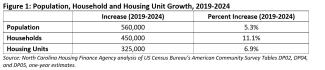
While North Carolina’s population is increasing, the number of households is growing even faster. While at first glance, these sound like they should move in tandem, “a household consists of all the people who occupy a housing unit,”[ii] and the number of such households can move at different rates depending on changes over time of average household size. Between 2019 and 2024, the population increased by 5.3% and, in that same time period, the total number of households increased by 11.1%.[iii] In raw numbers, during those five years, the population grew by about 560,000 people and the number of households grew by about 450,000. However, the number of housing units only increased by about 325,000.[iii] All told, this means that in those five years, household formations outpaced unit formation by 125,000 housing units. See Figure 1 below.
Geographic Shifts
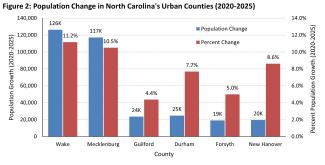
Population growth is not constant across North Carolina. Some areas of the state are experiencing rapid growth while others experience slow-to-no growth or even population decline. More urban areas are experiencing rapid growth while rural areas are more of a mixed bag with some counties experiencing population growth and others experiencing population stagnation or decline. For example, all six urban counties in the state, as defined by the North Carolina Rural Center[iv], experienced population growth between 2020 and 2024.[v] See Figure 2 below.
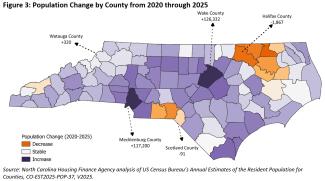
In rural counties, there is greater variability. Twelve counties have experienced population decline while 9 counties have experienced population growth of more than 5,000 people between 2020 and 2025. Meanwhile, during the same time period, 26 rural counties had relatively stable populations with population growth or loss at less than 2% during those five years.[v] See Figure 3 below.
Demographic Change: An Increasingly Diverse and Older State
Race and Ethnicity
As of 2024, 59.0% of North Carolinians identified as white (non-Hispanic). In 2019, this figure was 62.5%.[vi] Figure 4 below details the shift in demographics from 2019 through 2024 in North Carolina:
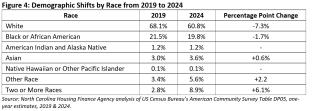
In addition to the data shown in the table above, the proportion of North Carolinians identifying as Hispanic has also increased since 2019. From 2019 through 2024, the percentage of people in the state identifying as Hispanic increased from 9.8% to 12.0%.[vi]
Age
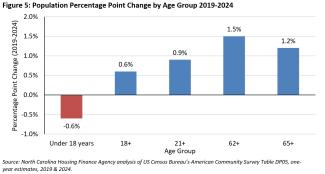
On average, North Carolina’s population is getting older. As of 2024, the statewide median age is 39.4 years old, up from 39.1 in 2019. About 21.3% of the population is under age 18, and 17.9% is aged 65 or over. The percentage of North Carolinians under 18 years old decreased between 2019 and 2024 by 0.6 percentage points (from 21.9% to 21.3%) while those aged 65 or over increased by 1.2 percentage points (from 16.7% to 17.9%). Moreover, while the proportion of North Carolinians under 18 shrunk, the proportions over 18, over 21, over 62 and over 65 all increased.[vi] See Figure 5 below.
Assisting North Carolinians: NC Housing Finance Agency
North Carolina’s growing and changing population will bring new opportunities but also deeper housing challenges. The NC Housing Finance Agency’s programs are designed to meet these changes and challenges head‑on by supporting lower income and more vulnerable residents so that all North Carolinians can share in the state’s future.
The Agency provides a variety of programs and products to assist North Carolina’s population across all walks of life. Among other programs, the Agency provides low-cost mortgages and down payment assistance for new and move-up homebuyers; finances affordable homes and apartment development by local government, nonprofit and private owner partners; finances the development of housing for people with special needs; and finances the repair and rehabilitation of owner-occupied homes.
Since its inception, the NC Housing Finance Agency has financed over 330,000 affordable homes and apartments. To learn more about the NC Housing Finance Agency and its programs, visit www.nchfa.com.
-----------
[i] North Carolina Housing Finance Agency analysis of US Census Bureau’s Annual Estimates of the Resident Population for Counties, CO-EST2025-POP, V2025. Available here.
[ii] US Census Bureau. Subject Definitions: Household. Available here.
[iii] North Carolina Housing Finance Agency analysis of US Census Bureau’s American Community Survey Tables DP02, DP04, and DP05, one-year estimates. Available here.
[iv] The urbanicity of a county is based on North Carolina Rural Center’s (NCRC) categorization which determines each county as “urban,” “suburban” or “rural.” NCRC’s categorization provides 78 rural counties, 16 suburban counties and 6 urban counties. More information may be found here.
[v] North Carolina Housing Finance Agency analysis of US Census Bureau’s Annual Estimates of the Resident Population for Counties, CO-EST2025-POP-37, V2025. Available here.
[vi] US Census Bureau. American Community Survey Tables DP05, one-year estimates, 2019 and 2024. Available here.