When we talk about the need for more affordable rental housing, the solution can sound simple: build more apartments and make the rents affordable. In practice, it is much more complicated. Behind every affordable home is a complex puzzle of land, construction, financing, insurance, taxes, ongoing operations and long-term affordability.
What does it take to turn the idea of affordable rental housing into actual homes with rents that are affordable for decades to come?
The Affordability Equation
The most visible aspect of creating a new multifamily rental development is the physical construction itself, but construction represents only one component of a much larger and more complex effort. Developing multifamily rental housing typically entails a range of expenses, including:
- Land acquisition and site preparation
- Construction (materials and labor)
- Infrastructure
- Architecture and engineering
- Permits and other local impact fees
- Legal and professional services
- Financing
- Insurance
- Taxes
- Reserves for future repairs and capital needs
- Other costs required to bring a property from concept to completion
These costs and complexities can vary from one community to another. For example, a project in a high-cost or growing housing market may face intense competition for land and complex local land use regulations.[i] A development in a rural community may face different challenges: while construction costs may be similar to those in an urban market, local incomes are often too low to support the rents needed to cover project debt; contractors may be in short supply; and suitable land may lack infrastructure.[ii]
While conventional multifamily rental developments rely on tenant rent payments to support their development and ongoing operating costs, affordable housing operates differently. Developers plan to make these rental homes available to lower income households at affordable rents for a length of time, which limits the amount of rental income a property can generate. Often, there is a financing gap between what it costs to build an affordable housing development and what affordable rents can support. A range of public and private financing tools help close this gap, from a traditional bank loan (i.e., hard debt) to equity generated from the sale of tax credits to project-specific financing (e.g., soft debt in the form of low or zero-interest loans and/or grants).
One of the biggest and most important tools in North Carolina is the federal Low-Income Housing Tax Credit (“Housing Credits”), administered in the state by the North Carolina Housing Finance Agency. Developers compete for an allocation of federal Housing Credits and selected projects agree to maintain affordable rents and comply with program requirements in exchange for these credits. Rather than functioning like a traditional loan, owners sell the credits to investors with the resulting proceeds serving as equity to reduce the amount of debt the property needs. This debt reduction is critical: less debt means lower debt payments and lower debt payments help make it possible for a property to operate with affordable rents. Figure 1 below helps illustrate this structure.
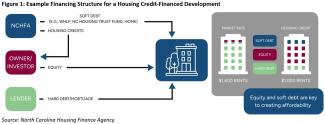
Most affordable housing developments use hard debt with equity from Housing Credits, then fill the remaining financing gaps with other sources that align with the project’s goals and structure. The Workforce Housing Loan Program (WHLP) is one example of a gap financing tool in North Carolina. Also administered by the Agency and appropriated by the General Assembly, WHLP provides loans for the construction and rehabilitation of affordable rental housing. The loans, combined with Housing Credits, make affordable rental development feasible in low-income, rural counties—where rents are not high enough to cover building costs and repay development loans—and help reduce rents in high-cost urban areas.
In addition to WHLP, the Agency leverages other federal and state funds to provide gap financing to Housing Credit-financed developments (see the Rental Production Program (RPP)). Beyond soft debt from the Agency, Housing Credit developments can leverage gap financing from federal programs, city and county housing funds, resources from other state agencies and philanthropic dollars.
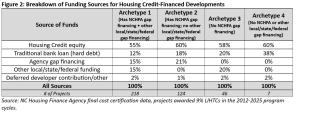
While the exact mix of financing varies from development to development, Figure 2 below shows the typical breakdown of funding sources for Housing Credit-financed developments in North Carolina for three different project archetypes.
Affordability in Practice
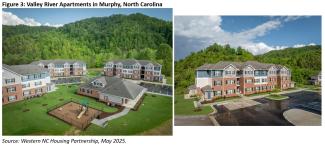
Valley River Apartments in Murphy, North Carolina is just one example of how different public resources can work together to address challenges that are bigger than any one agency or program. This 56-unit family development in Cherokee County serves households earning up to 60% of the area median income (AMI).[iii]
In addition to Housing Credits and a traditional bank loan, Valley River Apartments received Agency support from WHLP and RPP, and a grant from Dogwood Health Trust. The Town of Murphy also utilized funding from the Community Development Block Grant-Neighborhood Revitalization (CDBG-NR) program, federal financing administered by the NC Department of Commerce to build and improve the public infrastructure needed to make Valley River Apartments possible.[iv] In acknowledgement of the creative and complex system of partnerships and financing that made this affordable housing development possible, Valley River Apartments received a 2026 Housing North Carolina Award in the creative partnerships category.
Valley River Apartments also illustrates how a community’s housing needs evolve over time. Cherokee County, like many communities across western North Carolina, was already facing housing affordability challenges before Tropical Storm Helene.[v] While the storm’s impacts in Murphy were limited primarily to communication outages and isolated flooding, Helene underscored the region’s wider housing pressures—from limited buildable land to a tight supply of affordable rental homes to persistent workforce housing needs. While Valley River Apartments was under construction when Helene hit in 2024, it is a reminder that resilience is not simply about replacing what was lost: it is also an opportunity to invest in and strengthen the housing supply that communities will depend on for years to come.
From a Financing Concept to a Front Door
For the residents of Valley River Apartments, the story is less about financing programs and capital stacks and more about having a safe, affordable place to live. These rental homes are designed to be affordable for households earning 50-60% AMI—about $47,000 for a four-person household in Cherokee County—so that the Murphy residents can live near school, work and family: hospitality and service industry staff, retail associates, janitorial crews, home health aides, vet clinic staff, carpenters, mechanics, construction workers and truck drivers.[vi] None of this can happen without careful coordination behind the scenes. In communities across North Carolina, where the need for affordable rental homes continues to grow, understanding that process matters.
The lesson is straightforward: affordable rental housing is not simply about setting an affordable rent. It is about building a financing structure that makes that rent possible.
To learn more about the Agency’s multifamily rental development financing tools, programs and portfolio, visit https://www.nchfa.com/rental-housing-partners.
-----------
[i] See, for example: Greenburg, B. & Bodulovic, T. (2026). “Using Public Land for Affordable Housing: Considerations for Policymakers.” Lincoln Institute of Land Policy. Available here.
[ii] See, for example: Dumont, A. (2018). “Rural Affordable Rental Housing: Quantifying Need, Reviewing Recent Federal Support, and Assessing the Use of Low Income Housing Tax Credits in Rural Areas.” Federal Reserve Board of Washington, D.C. Available here.
[iii] For 2026, 60% area median income is equivalent to an annual household income of $47,000 for a family of four in Cherokee County. The 2026 Multifamily Tax Subsidy Program (MTSP) Income & Rent Limits, utilized by the LIHTC program, are available here.
[iv] Town of Murphy. (November 27, 2023). Town of Murphy Announces New Affordable Housing with Valley River Apartments [press release]. Available here.
[v] NC Housing Finance Agency’s NC Housing Snapshot, accessed September 1, 2026.
[vi] U.S. Bureau of Labor Statistics. (Q1 2026). Quarterly Census of Employment and Wages: Private, High-Level Industries, Cherokee County, North Carolina [dataset]. Available here.